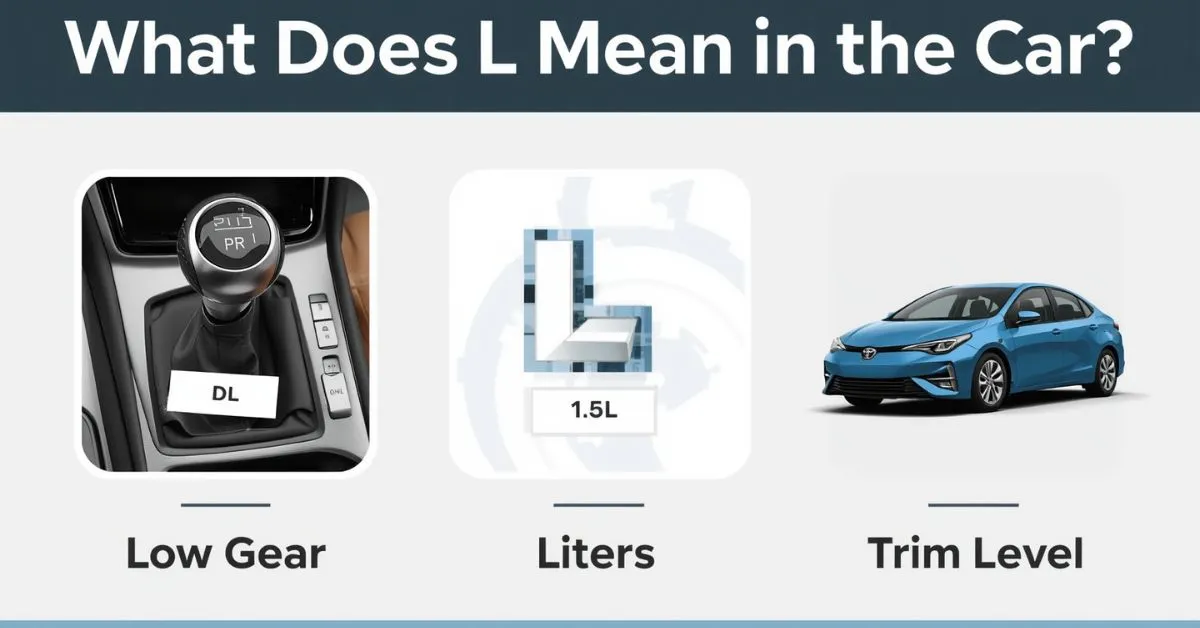
Most of the time, when people ask what “L” means in a car, they mean the letter on the automatic gear selector. In that context, L means Low gear. It helps the vehicle stay in lower gears for better control, more engine braking, and more pulling power at lower speeds. In other places, though, L can also mean liters in engine size or part of a trim name.
That is why this question confuses so many drivers: the same letter can mean different things depending on where you see it. On the shifter, it usually means Low. After a number like 2.0L, it means liters. In a model name or badge, it can be part of a trim designation, and the exact meaning varies by brand.
If you want the fastest answer, use this rule:
- L on the shifter = Low gear
- L after a number = liters
- L in the model name = usually a trim level or trim code
What Does L Mean on a Car’s Gear Shift?
On an automatic transmission, L stands for Low gear. It tells the transmission to stay in its lowest gear, or lowest few gears, instead of shifting normally through the full range in Drive. That gives you more control at lower speeds, more engine braking on descents, and more torque when the car needs pulling power rather than speed.
You will often see it alongside the familiar P-R-N-D positions that make up PRNDL: Park, Reverse, Neutral, Drive, and Low.
What Low gear actually does
In normal Drive, the transmission shifts up and down automatically to balance acceleration, fuel economy, and comfort. In L, the transmission holds lower gears longer and may stop itself from shifting into higher gears at all. That means the engine spins faster for a given road speed, which increases engine drag for slowing the car and gives the wheels more usable torque at low speed.
That is the practical reason Low gear exists: not to make the car faster, but to make it more controlled and more capable in specific situations.
When Should You Use L Gear?
1) Driving down a steep hill
This is one of the most important uses. On a long downhill grade, Low gear lets the engine help slow the vehicle instead of making the brakes do all the work. That is called engine braking. It can reduce brake heat and lower the risk of brake fade, which is when overheated brakes temporarily lose effectiveness.
A simple way to picture it: if you descend a steep road in Drive, the car may keep picking up speed and force you to keep pressing the brake pedal. In Low gear, the car naturally resists speed more, so you do less “riding the brakes.”
2) Climbing a steep hill
Low gear can also help on steep uphill roads. By staying in a lower gear, the transmission keeps the engine in a range where it can deliver more pulling power at lower speed. That can make the car feel more stable and less reluctant on a long incline.
3) Towing or hauling a heavy load at lower speeds
If the vehicle is towing a trailer or carrying a heavy load, Low gear can help it pull more confidently from a stop or on a grade. Several current explainers also note that newer vehicles may use tow/haul modes or manual gear selection instead of a literal “L,” but the idea is similar: keep the vehicle from upshifting too early when more control or torque is needed.
4) Slippery, rough, or low-speed traction situations
Low gear may also help in situations like snow, mud, ice, or off-road driving, especially where slow wheel speed and steady torque matter more than speed. It is not a magic traction fix, but it can support smoother, more controlled movement in those conditions.
When Should You Not Use L Gear?
Low gear is not the right setting for normal everyday cruising on flat roads or highway driving. It keeps the engine revving higher than necessary, reduces comfort, and limits how the transmission normally shifts for efficiency and speed.
In practical terms, that means:
- do not leave it in L for routine city or highway driving
- do not use it just because you want “more power”
- do not treat it like a sport mode
- do not assume it is better than Drive for everyday use
Low gear is for specific low-speed or high-control situations, not regular commuting.
What Happens If You Drive in L by Mistake?
Usually, the car will not suddenly break just because you selected L for a short time. What you will usually notice first is different behavior:
- the engine revs higher
- the car feels slower at higher road speeds
- the transmission holds low gears
- the cabin gets noisier
- the car feels less smooth and less efficient
That said, Low gear is not intended for sustained higher-speed driving. Because it holds lower gears, engine RPM can climb quickly, and the vehicle may feel strained or limited if you try to drive normally for too long. Exact behavior depends on the vehicle, so the safest habit is simple: use L only when you need it, then return to Drive when the situation is over.
L vs D vs 1 vs 2 vs Manual Mode
Many drivers assume every car uses the same shifter layout. They do not. Some vehicles show L. Some show 1, 2, or 3. Others use M, +/-, paddle shifters, or special drive modes. The goal is often the same: limit upshifts and keep the vehicle in a lower gear range when the driver wants more control.
| Selector position | What it means | Best use case | What it does |
|---|---|---|---|
| D | Drive | normal everyday driving | lets the transmission shift through its normal range |
| L | Low gear | steep hills, descents, towing, low-speed control | keeps the vehicle in low gear or low gears |
| 1 / 2 / 3 | lower gear limits | older automatics or alternative layouts | restricts the highest gear the transmission can use |
| M / +/- | manual mode | newer vehicles that do not have L | lets the driver choose or limit gears manually |
| B | braking mode in some hybrids/EVs | downhill control and stronger slowing effect | increases deceleration, often through regenerative braking rather than a conventional low gear |
The key point is that L is one version of a broader idea: giving the driver more control over lower gear operation when Drive is not the best choice.
Why Some Cars Don’t Have an L Anymore
Many newer vehicles do not show an L on the gear selector because modern transmissions offer other ways to get the same effect. Some use manual mode, some use paddle shifters, some show 1/2/3, and some hybrids use B mode for stronger deceleration. In other words, the function still exists in many cars even when the letter L does not.
That is also why checking the owner’s manual matters. One car’s “L” may hold first gear longer, while another vehicle may allow the lowest two gears. The exact behavior is not identical across every make, model, or transmission.
What Does 2.0L Mean in a Car?
If you see L after a number, such as 1.5L, 2.0L, or 3.6L, the L means liters. In that context, it refers to engine displacement, not the gear selector. You will see this in specs, ads, window stickers, and reviews describing engines like a “2.0-liter four-cylinder” or “3.6-liter V-6.”
A bigger liter number often points to a larger engine, but it does not tell you everything about performance by itself. Turbocharging, gearing, vehicle weight, and engine design all matter too. A smaller turbo engine can outperform a larger older engine in some real-world situations. That is why 2.0L means engine size, not total power.
What Does L Mean in a Car Model Name?
If the L appears in the model name or badge, it is usually part of the vehicle’s trim designation rather than the transmission or engine size. In that case, it helps identify which version of the model you are looking at. The exact meaning can vary by brand and model year, so it is safer to treat it as a trim code than to assume it always means “luxury,” “limited,” or “base model.”
For example, if you see something like Corolla L, the letter is part of the trim lineup. If you want to confirm exactly what features that trim includes, use the window sticker, VIN-based vehicle information, or the manufacturer’s trim breakdown for that model year. CARFAX notes that VIN-based lookups can reveal details such as trim.
How to Tell Which Meaning Applies in Seconds
Here is the easiest way to decode it:
If it is on the gear selector
It almost always means Low gear.
If it comes after a number
It means liters, as in engine displacement.
If it appears in the model name or badge
It is probably a trim designation.
That single context check solves most of the confusion around this keyword.
What Most Articles Miss About This Topic
Most articles make one of two mistakes:
They either explain only the gear-shift meaning and ignore the other common uses, or they explain the three meanings so evenly that they miss what most searchers want first.
The more useful explanation is this:
- The dominant real-world meaning is L on the shifter = Low gear. That is the version drivers most often need help with.
- But L is not universal. The same letter also shows up in engine sizes and trim names.
- Placement matters more than the letter itself. If you know where you saw the L, you can usually decode it immediately.
- Modern cars may not show L at all. They may use 1/2/3, M, +/-, paddle shifters, tow/haul modes, or B mode instead.
That context-first approach is what helps readers stop searching and move on with confidence.
FAQ
Does L mean Low gear?
Yes, on the gear selector it usually means Low gear. It keeps the transmission in lower gears for more control, stronger engine braking, and more low-speed torque.
Can I drive in L all the time?
You generally should not. Low gear is meant for specific situations like steep hills, towing, or low-speed control, not normal everyday driving or highway cruising.
Is L the same as 1 or 2 on the shifter?
Not exactly, but they are closely related. Many vehicles use 1, 2, or 3 instead of L to limit the transmission to lower gears. L is often the most restrictive low-range setting.
Does L save your brakes downhill?
It can help reduce brake use on long descents by using engine braking to slow the vehicle, which lowers brake heat and helps reduce the risk of brake fade.
What does 2.0L mean in a car?
It means the engine is 2.0 liters in displacement. In that case, the L stands for liters, not Low gear.
Does L in a model name mean luxury?
Not necessarily. In a model name, L is often part of a trim designation, and the exact meaning varies by manufacturer. It is better to verify the specific trim for that car and model year.
Conclusion
If you are asking what does L mean in a car, the answer depends on where you saw it, but the most common meaning is simple:
On the shifter, L means Low gear.
Use it when you need extra control at lower speeds, especially on steep hills, long descents, while towing, or in low-speed traction situations. If you see 2.0L, it means liters. If you see L in the model name, it is usually a trim code.
For the safest interpretation in a specific vehicle, check the owner’s manual or the exact trim and engine listing for that model year, because the details can vary by transmission and brand.
Click Here To Read About : what does integrated mean

Hi, I’m Geoffrey Chaucer. I explore the stories and meanings behind words, turning ideas into clear, insightful writing. Through every article I craft, I aim to spark curiosity, share knowledge, and help readers uncover practical, meaningful truths in everyday life.