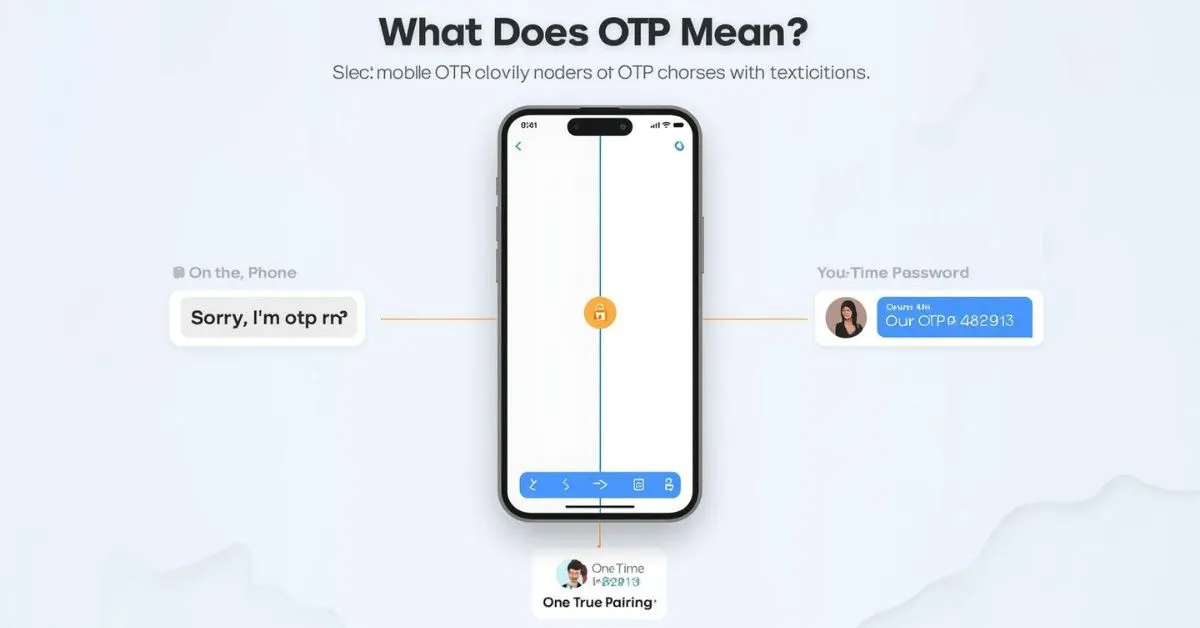
OTP in text can mean three different things: “on the phone,” “one-time password,” or “one true pairing.” In casual messages, it often means “on the phone.” In banking or login texts, it usually means “one-time password.” Meanwhile, in fandom and social media conversations, it can mean “one true pairing.” The correct meaning depends on the context.
If you searched this because you saw OTP in a message, you are not alone. At first glance, the term looks simple. In reality, though, it can point to very different meanings depending on who sent it, where you saw it, and what the conversation is about.
What OTP Usually Means by Context
| Where you saw OTP | What it usually means | Example | What to do |
|---|---|---|---|
| A casual text from a friend | On the phone | “Sorry, I’m otp rn” | Read it as “I’m on a call” |
| A bank, app, or login message | One-time password | “Your OTP is 483921” | Use the code only if you requested it |
| A fandom or social media post | One true pairing | “They’re my OTP” | Read it as a favorite fictional couple |
The 3 Main Meanings of OTP
1) OTP = On the Phone
In regular texting, OTP often means “on the phone.” People use it to say they are currently talking to someone and cannot reply properly.
You might see messages like:
- “I’m otp right now”
- “Sorry, otp with my mom”
- “Can’t talk much, I’m otp”
- “otp rn, ttyl”
In each of these examples, the meaning is simple: the person is on a call. As a result, they are letting you know their replies may be short or delayed.
This use is especially common in:
- casual texting
- iMessage chats
- WhatsApp messages
- fast back-and-forth conversations
- slang-heavy replies
2) OTP = One-Time Password
In security and account-related messages, OTP means “one-time password.” In other words, it is a temporary code sent by SMS, email, or an app to confirm your identity.
Examples include:
- “Your OTP is 752114”
- “Enter this OTP to continue login”
- “Do not share your OTP with anyone”
You will usually see this meaning in:
- bank texts
- shopping checkout verification
- password resets
- account login alerts
- two-factor authentication or multifactor authentication flows
So, if a message includes numbers, verification, login, account access, or security language, OTP almost certainly means one-time password.
3) OTP = One True Pairing
In fandom, pop culture, and social media spaces, OTP can mean “one true pairing.” That phrase refers to a favorite couple, usually fictional, that someone strongly supports.
Examples:
- “They’re my OTP from that show”
- “I still love them as an OTP”
- “That series gave me a new OTP”
This meaning appears more often on:
- Tumblr
- TikTok
- fandom forums
- X posts
- comment sections about shows, books, anime, movies, or celebrity pairings
Therefore, if the conversation is about characters, relationships, shipping, or fan opinions, OTP likely means one true pairing.
How to Tell Which OTP Meaning Fits in Seconds
The fastest way to decode OTP is to check the message around it. Context matters far more than the letters alone.
If a friend texted it
It usually means on the phone.
Example:
“Can I call you later? I’m otp rn.”
If the message includes a code
It usually means one-time password.
Example:
“Your OTP is 384220. It expires in 10 minutes.”
If the post is about characters or couples
It usually means one true pairing.
Example:
“They were my OTP until the final season.”
A simple rule helps:
- Casual chat = probably on the phone
- Security or login text = probably one-time password
- Fandom or relationship discussion = probably one true pairing
What Does “I’m OTP” Mean in Text?
If someone says “I’m otp,” they almost always mean:
“I’m on the phone.”
Basically, it is a quick way of saying:
- I’m on a call right now
- I can’t text properly
- I’ll reply later
For example:
- “I’m otp, give me 10”
- “Can’t explain rn, I’m otp”
- “I’m otp with my sister”
In most casual chats, this is the most common real-world use of OTP.
What Does “OTP RN” Mean?
“OTP rn” means “on the phone right now.”
Here, “rn” simply means “right now.” You may also see close variations such as:
- “im otp rn”
- “otp atm”
- “still otp”
- “was otp”
In short, the sender is saying they are busy on a call at that moment.
What Does OTP Mean on Snapchat, TikTok, or Social Media?
On Snapchat or in direct messages, OTP may still mean on the phone, especially if someone sends a short reply like:
- “otp rn”
- “sorry, otp”
- “brb otp”
On TikTok, Tumblr, fandom pages, or entertainment discussions, however, OTP is more likely to mean one true pairing.
Examples:
- “They’ve been my OTP since season one”
- “This edit made me ship them again, total OTP”
- “New OTP unlocked”
So the platform matters:
- private chat: often on the phone
- public fandom content: often one true pairing
OTP in a Verification Text or SMS
If you get OTP in a text from a bank, website, or app, it usually means one-time password.
This type of code is commonly used to:
- sign in
- confirm your identity
- approve a purchase
- reset a password
- complete account verification
These messages often come from:
- a short code
- a company name
- an automated sender
- a service you are actively trying to access
For example:
“Your OTP is 551208. Do not share this code.”
Is OTP the Same as a Verification Code?
Often, yes. In practice, many companies use OTP and verification code in almost the same way.
There is, however, a small difference in wording:
- OTP emphasizes that the code is temporary and valid for one use
- Verification code is the broader plain-language term many users already understand
So, for most readers, if a text says OTP, you can safely read it as a temporary login or confirmation code.
Why Did I Get an OTP Text I Didn’t Request?
If you receive an OTP text you did not ask for, a few things may be happening:
- someone entered your phone number by mistake
- someone tried to log in to your account
- someone is attempting a password reset
- it may be part of a phishing or scam attempt
Because of that, you should:
- not share the code
- avoid clicking suspicious links
- check whether you recently tried to log in anywhere
- change your password if you think your account may be at risk
- review your account security settings if needed
Most importantly, a real OTP should never be shared with another person. If someone asks you to send it to them, that is a major red flag.
OTP vs Ship: What’s the Difference?
In fandom language, ship and OTP are related, but they are not exactly the same.
- Ship means you support a romantic pairing between two characters or people
- OTP means your favorite pairing above all others
So someone might say:
- “I ship them” = I like them together
- “They’re my OTP” = they are my top favorite pairing
This distinction matters because readers coming from fandom spaces often want more than a plain definition. They want to know how the term is actually used in conversation.
Common Mistakes People Make With OTP
Thinking OTP always means “on the phone”
That is common in casual texting. However, it is not the only meaning.
Assuming OTP always means a security code
That is true in banking or login texts. In normal friend-to-friend messages, though, it is often wrong.
Missing the fandom meaning
If you see OTP in a post about a show, anime, celebrity pairing, or fictional couple, it may mean one true pairing, not “on the phone.”
Overreading the message
If someone texts “otp rn,” they usually are not sending a hidden message. Instead, they are simply saying they are busy on a call.
Real Examples of OTP in Different Situations
Casual text
“Sorry, I’m otp rn. I’ll reply after.”
Meaning: on the phone
Login message
“Use OTP 842993 to sign in to your account.”
Meaning: one-time password
Fandom post
“They were my OTP long before the finale.”
Meaning: one true pairing
Group chat reply
“Can someone fill me in later? I’m otp.”
Meaning: on the phone
App security text
“Your OTP code expires in 5 minutes.”
Meaning: one-time password
What Most Articles Miss About This Topic
Most articles give a short list of meanings and stop there. That helps a little, but it does not solve the real problem readers have.
Usually, people do not search this term because they want a dictionary entry. Instead, they search it because they just saw OTP in a real message and want to understand it correctly.
That is why the most useful explanation is not just a definition. It is a context-based guide.
Here is the clearest way to think about it:
- If a friend texts “I’m otp,” it usually means on the phone
- If a company sends OTP with a code, it means one-time password
- If someone is talking about a couple or characters, it means one true pairing
Once you use that framework, the meaning becomes much easier to spot.
FAQ
What does OTP mean in a text message from a friend?
Usually, it means on the phone.
What does “I’m otp” mean?
It means “I’m on the phone.”
What does OTP mean in a bank text?
It means one-time password, which is a temporary code used for verification or login.
What does OTP mean on Snapchat?
In private chat, it often means on the phone. In fandom-style content, though, it may mean one true pairing.
What does OTP mean on TikTok?
Often, it means one true pairing when people are discussing characters, couples, edits, or fan content.
Is OTP always romantic?
No. In many everyday messages, it simply means on the phone.
Is OTP always a one-time password?
No. That meaning is common in account and security texts, but not in normal casual conversation.
What should I do if I get an OTP code I didn’t request?
Do not share it. Instead, treat it as a possible security issue and check your account if needed.
Conclusion
If you are wondering what OTP means in text, the best answer is: it depends on the context.
The three common meanings are:
- on the phone
- one-time password
- one true pairing
If it is a casual text from a friend, OTP usually means on the phone. By contrast, if it is a login or banking message, it usually means one-time password. In fandom or social media conversations, meanwhile, it may mean one true pairing.
Click Here To Read About : what does it mean to be autistic

I am Clara Lexis, a writer driven by clarity, depth, and authenticity. My focus is on transforming ideas into meaningful content that is both informative and engaging. I write with intention to communicate clearly, thoughtfully, and with purpose.