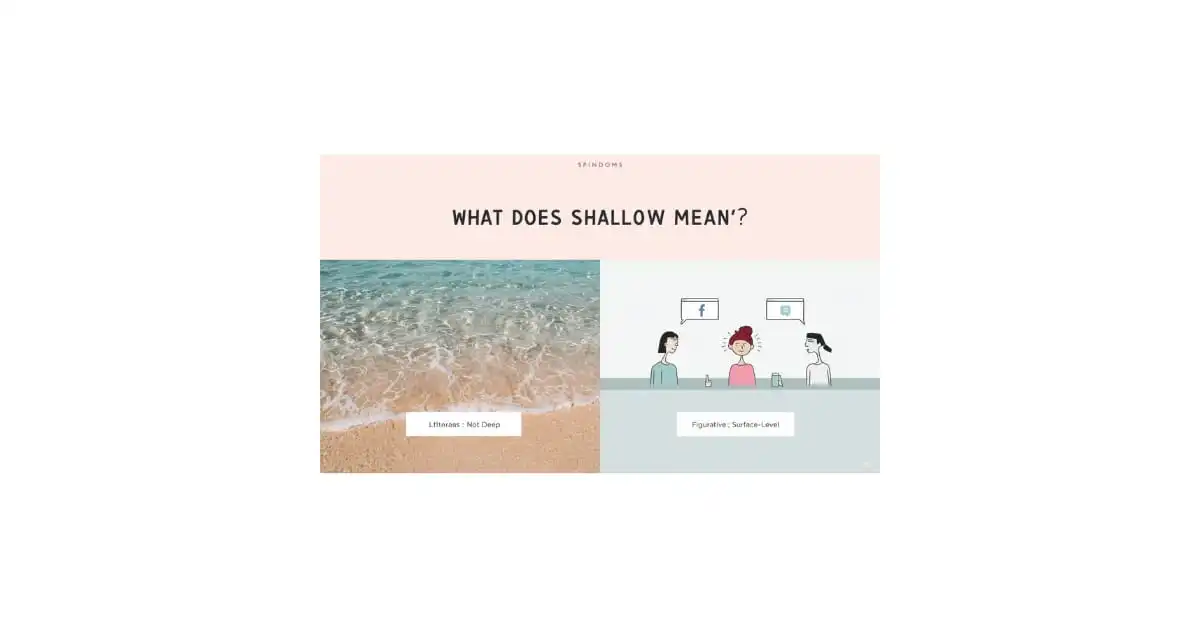
Shallow usually means “not deep.” It can describe something physical, like shallow water, or something figurative, like shallow thinking, a shallow relationship, or a shallow person. In everyday English, it often suggests that something stays on the surface instead of having real depth, meaning, or substance.
If you want the quick answer, that is the core meaning. But the word shallow can sound neutral, practical, or critical depending on how it is used. That is where many people get confused.
Meaning at a Glance
| Context | Meaning | Tone | Example |
|---|---|---|---|
| Water | Not deep | Neutral | The water is shallow near the shore. |
| Bowl, tray, pan | Has little depth | Neutral | Use a shallow dish for baking. |
| Person | Focused too much on surface-level things | Usually negative | People called him shallow because he judged others by looks. |
| Conversation | Lacking depth or real substance | Often negative | Their talk stayed surface-level all evening. |
| Relationship | Surface-level, not emotionally deep | Often negative | The friendship felt pleasant but lacked real depth. |
| Thinking or analysis | Not thoughtful or not developed enough | Negative | That argument seems underdeveloped. |
| Breathing | Light, weak, or not deep | Usually descriptive | Anxiety can sometimes cause shallow breathing. |
What Does Shallow Mean in Simple English?
In simple English, the term means not deep.
That central idea works in two main ways:
Literal meaning: lacking depth in a physical sense
Figurative meaning: lacking depth in thought, feeling, meaning, or character
So when someone asks for the simple meaning, the clearest answer is:
It refers to something with little depth, either physically or in a more emotional, intellectual, or personal way.
Literal Meaning
The most direct use is physical.
It describes something that does not have much depth.
Common literal examples
- water near the shore
- a dish with little depth
- a pan with low sides
- a hole that is not deep
- the end of a pool meant for standing
Example sentences
- The river looks wide, but it is quite shallow.
- Put the mixture into a shallow baking dish.
- Children should stay in the shallow end.
In these cases, the term is neutral. It is simply describing depth.
Figurative Meaning
The figurative sense is where the word becomes more interesting.
When used figuratively, it usually suggests that something lacks depth, seriousness, complexity, or emotional substance.
It may describe:
- a person
- a conversation
- a relationship
- an opinion
- an article
- a character in a story
Example sentences
- The discussion felt shallow and avoided the real issue.
- The movie looked beautiful, but the story was shallow.
- She wanted deeper friendships, not shallow ones.
In this sense, it often implies that something stays on the surface and never goes further.
What Does It Mean for a Person?
When people use this word for a person, they usually mean that the person seems too focused on surface-level things.
That may include:
- physical appearance
- money
- status
- popularity
- image
- first impressions
Example
- He seemed shallow because he cared more about looks than character.
This is usually a negative description. It suggests that the person may not value deeper qualities such as honesty, empathy, intelligence, loyalty, or emotional depth.
Still, context matters. People sometimes use the label too quickly or unfairly. Someone can enjoy fashion, beauty, or social life without actually fitting that description.
Is It a Negative Word?
Not always.
Neutral uses
These are ordinary, non-judgmental:
- shallow water
- shallow pan
- shallow drawer
- shallow roots
Negative or critical uses
These often carry judgment:
- shallow person
- shallow relationship
- shallow conversation
- shallow analysis
So the word itself is not automatically harsh. It becomes negative when it suggests that something important is missing beneath the surface.
Other Common Uses
Many articles stop at water and personality, but the term appears in several other common contexts too.
Shallow breathing
This means breathing that is light or not deep.
Example:
Stress can lead to fast, shallow breathing.
The shallows
This refers to water that is not deep, especially near the edge of a lake, river, or sea.
Example:
Small fish gathered in the shallows.
Shallow roots
When roots are described this way, it means they stay close to the surface of the soil.
Example:
These plants have shallow roots and need regular watering.
As a verb
Less commonly, the word can be used as a verb meaning to make something less deep or to become less deep.
Example:
Over time, the channel began to shallow.
This form is much less common in everyday conversation than the adjective form.
In sports or position
In sports, the term can describe a position that is closer than usual.
Example:
The outfielder was playing shallow left.
Shallow vs Superficial vs Deep
These words are related, but they are not identical.
| Word | Core idea | Common use |
|---|---|---|
| Shallow | Lacking depth | People, conversations, ideas, water |
| Superficial | Concerned mainly with the surface | Appearance, judgments, analysis |
| Deep | Having strong meaning, feeling, or substance | Thought, emotion, relationships, water |
Surface-Level vs Superficial
These often overlap.
A superficial comment focuses only on outward details.
A surface-level comment may also lack emotional or intellectual depth.
In everyday use, many people treat them as near-synonyms. But the first term is slightly broader.
Surface-Level vs Simple
A simple explanation can be good because it is clear.
A surface-level explanation is usually less effective because it leaves out important depth.
That is an important difference.
Common Collocations
These are word pairings you will often see in English:
- water near the shore
- the end of a pool meant for standing
- roots close to the surface
- light breathing
- a grave with little depth
- a dish with low sides
- a person focused on appearances
- surface-level thinking
- a conversation with little substance
- a relationship without much emotional depth
Knowing these common pairings makes the term easier to recognize in real use.
How to Use It in a Sentence
Here are clear examples across different contexts.
Literal examples
- The stream is too low for a boat.
- Pour the sauce into a pan with low sides.
- We stood in the water near the beach where the bottom was easy to see.
Figurative examples
- Their friendship felt warm but lacked real depth.
- The article raised a big question but gave a surface-level answer.
- I was hoping for a meaningful discussion, but it stayed at the surface.
Describing a person
Calling someone this usually means they care too much about appearances or other surface-level things.
It is unfair to label someone that way based on one short interaction.
What Is the Opposite?
The most common opposite is deep.
Depending on the sentence, other opposites may include:
- thoughtful
- meaningful
- profound
- serious
- emotionally rich
- complex
Examples
- water near the shore ↔ deep water
- surface-level thinking ↔ deep thinking
- a weak connection ↔ a deep connection
Common Mistakes People Make With This Word
Thinking it always sounds rude
It is not rude when used physically.
For example:
- The lake is shallow.
- Use a shallow tray.
Those are neutral.
Thinking it always means someone is uninformed
Not exactly.
A person described this way may be seen as overly focused on appearance or status, but that does not automatically mean they are uninformed or lacking intelligence.
Thinking it and simple mean the same thing
They do not.
Simple can be positive and clear.
This term usually suggests that something important is missing.
Thinking it only applies to people
It can describe many things:
- water
- breathing
- roots
- discussion
- writing
- relationships
- judgment
What Most Articles Miss About This Topic
Most pages explain that the term means not deep and then stop there. That is technically correct, but it misses the real reason people search this word.
The main confusion is not the basic definition. The confusion is how the tone changes depending on the context.
Here is the deeper point:
It often suggests more than “less depth”
It usually hints that something important is missing beneath the surface.
That missing depth might be:
- emotional depth
- serious thought
- real understanding
- meaningful connection
- stronger substance
It can be descriptive or judgmental
- Water near the shore is a neutral description.
- A surface-level conversation is an evaluation.
- Describing a person this way is usually criticism.
That shift matters.
It does not always mean fake
A conversation can lack depth without being dishonest. It may simply stay light and never become meaningful.
Context does most of the work
If you remember one thing, remember this question:
Depth of what?
That one question helps you interpret the word correctly almost every time.rrectly almost every time.
Quick Interpretation Rule
Use this shortcut:
- If the word is about water, containers, roots, or breathing, it is usually literal or physical.
- If it is about a person, relationship, thought, or conversation, it usually means lacking emotional or intellectual depth.
That is the easiest way to understand the term in English without overthinking it.
FAQ
What does it mean in one sentence?
It means not deep, either physically or in thought, feeling, meaning, or character.
What does it mean for a girl or a guy?
It usually suggests that the person is seen as caring too much about surface-level things such as looks, money, or social status rather than deeper qualities.
Is it an insult?
It can be. When used about a person, it often sounds critical. When used about water, dishes, or other physical things, it is neutral.
What does it mean in a relationship?
It usually means the relationship feels surface-level and lacks emotional depth, trust, or real closeness.
Does it mean superficial?
Often yes, but not exactly. Both suggest a focus on the surface, though this term can also point more broadly to a lack of emotional or intellectual depth.
What is the noun form?
The noun form is often shallowness. You may also see the shallows when talking about shallow water.
Can it be used as a verb?
Yes, though it is less common. It can mean to become less deep or to make something less deep.
What is the opposite?
The most common opposite is deep.
Conclusion
If you want the simplest answer to what does shallow mean, it means not deep.
That can refer to:
- physical depth, like water or a dish
- emotional depth, like a relationship
- intellectual depth, like an opinion or discussion
- personal depth, when describing someone’s values or priorities
The smartest way to read the word is to ask: depth of what?
Click Here To Read About : what does l mean in a car

I am Clara Lexis, a writer driven by clarity, depth, and authenticity. My focus is on transforming ideas into meaningful content that is both informative and engaging. I write with intention to communicate clearly, thoughtfully, and with purpose.