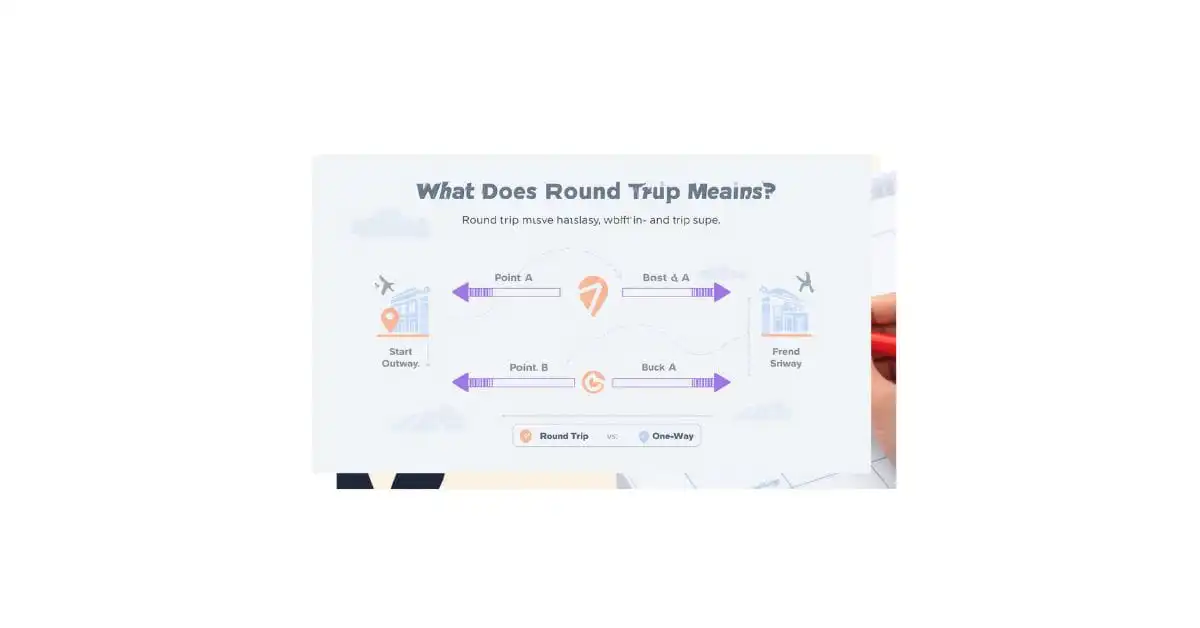
A round trip means traveling from your starting point to a destination and then returning to where you began. On a flight or ticket booking site, a round-trip ticket usually includes both the outbound trip and the return trip in one itinerary.
If you only need the quick answer, it’s this: round trip means there and back. You leave one place, go somewhere else, and return to your original starting point. Merriam-Webster defines it as a trip to a place and back, usually over the same route.
Most people see this term while booking a flight, train, or bus ticket. That is why the travel meaning matters most here: on booking forms, “round trip” tells the system you need both directions of travel, not just the first leg. Booking sites commonly place it next to “one-way” and “multi-city.”
Round trip meaning in simple terms
The easiest way to understand round trip is this:
Start somewhere → go to a destination → come back to where you started
That basic pattern is what makes it a round trip. It is not limited to flights. A drive to the airport and back home is also a round trip. A train ride to another city and then back again is a round trip too. Merriam-Webster’s definition covers the general journey pattern, not just airline tickets.
Quick examples
- Flight: Karachi to Dubai, then Dubai back to Karachi
- Train: Boston to New York, then New York back to Boston
- Driving: Home to the office and back home
In every case, the key idea is the same: you return to your original point of departure.
What does round trip mean on a flight or ticket?
On a booking site, a round-trip ticket usually means one itinerary that includes:
- an outbound trip from your origin to your destination
- an inbound or return trip back to your origin
Merriam-Webster defines a round-trip ticket as a ticket that lets a person travel to one place and then return to the place they left. Executive Flyers explains it similarly in flight terms: one ticket covering the outbound and inbound legs.
What a round-trip ticket usually includes
- your departure city or airport
- your destination city or airport
- your return date
- both travel directions in the same booking flow
That does not always mean the flights are identical in both directions. One leg might be nonstop and the other might include a connection. What matters most is that the itinerary brings you back to your starting point. Merriam-Webster notes that a round trip is usually over the same route, while travel publishers show that practical itineraries can still include different flight patterns.
Does round trip mean the same as return?
Usually, yes.
In travel, round trip and return ticket usually mean the same thing: travel out and back. The wording often depends on region or platform. Many U.S. sites use “round trip,” while other English-language markets often use “return.” The underlying meaning is generally the same.
Round trip vs one-way vs open-jaw vs multi-city
This is where many articles stay too basic. Readers usually do not just want the definition. They want to know how round trip compares to the other options they see on booking forms.
| Ticket type | What it means | Return included? | Best for |
|---|---|---|---|
| Round trip | Travel to a destination and back to your starting point | Yes | Fixed return plans |
| One-way | Travel in one direction only | No | Flexible or uncertain return plans |
| Open-jaw | You fly out to one city and return from another | Yes, but not from the same destination city | Multi-stop trips |
| Multi-city | You book several separate flight segments in one itinerary | Not necessarily | Complex travel plans |
Booking.com and NerdWallet both position round trip and one-way as the main basic options, while NerdWallet highlights open-jaw as a useful third option when your return city differs from your arrival city. Booking.com also uses “multi-city” as a standard search option alongside round trip and one-way.
Round trip vs one-way: which should you choose?
Choose round trip when:
- you already know when you are coming back
- your trip is straightforward
- you want a simple booking process
- the round-trip fare is competitive
Choose one-way when:
- your return date is uncertain
- you may return from a different place
- you want maximum flexibility
- two separate tickets price out better
Booking.com frames the choice around cost, flexibility, and when each option makes sense. NerdWallet adds that open-jaw or separate one-way bookings can sometimes be better depending on route and pricing.
Is round trip always cheaper than one-way?
No.
That is one of the biggest misunderstandings. Booking.com says round-trip and one-way pricing depends on the route and booking situation. NerdWallet’s fare comparisons show that round trip is often cheaper on many international routes, but that is not a universal rule. In some cases, separate one-way tickets can be competitive or more useful.
Best rule: compare all three when relevant:
- round trip
- two one-way tickets
- open-jaw or multi-city if you are not returning from the same place
Can a round trip include layovers or different routes?
Yes.
A round trip does not have to mean two nonstop flights or a perfectly mirrored route. The basic definition is “there and back.” In practice, your outbound flight might have a layover while your return is nonstop, or the flight numbers may differ. Merriam-Webster’s definition leaves room for variation by saying a round trip is “usually” over the same route, and travel booking guides routinely discuss round-trip flights with normal airline routing differences.
Example
You could fly:
- London to Rome with a stop in Amsterdam
- Rome back to London nonstop
That is still a round trip because you returned to your starting city.
Does round trip mean the same airport?
Not always, and this is where people get tripped up.
The core meaning of round trip is that you return to your original starting point. In everyday travel language, that is often understood at the city level. But when you are booking, what counts as “the same place” can depend on the itinerary and airport selection. A round-trip booking normally returns you to the origin in your reservation, but whether alternate airports in the same metro area are treated similarly depends on the airline, route, and search setup. Booking platforms also distinguish round-trip searches from more flexible multi-city searches for exactly this reason.
Can the return date be different?
Yes. In fact, that is normal.
Round trip does not mean same-day travel. It only means you leave and later return. Your return could be later that day, a week later, or months later, depending on the ticket rules and the kind of trip you are booking. Travel guides discussing one-way vs round-trip flights frame the difference around travel direction and flexibility, not same-day use.
What happens if you miss one leg of a round-trip ticket?
This is one of the most important practical details.
If you miss the first flight in a round-trip itinerary and do not cancel or change it in time, many airlines may treat you as a no-show and cancel the remaining segments of the ticket, including the return. American Airlines’ agency policy says customers who no-show without canceling before departure can lose the value of the remaining coupons, and Alaska Airlines also explains that partial itinerary cancellations need to be handled before departure to avoid problems. Delta’s no-show policy similarly warns that missed-flight handling depends on ticket status and exceptions.
The safest rule
If you think you might miss the outbound flight, contact the airline before departure. Do not assume the return flight will stay valid automatically. Airline handling varies by fare type and policy.
What if you do not use the return leg?
Sometimes people skip the final leg because their plans change. Whether you can change, cancel, or recover value from that unused portion depends on the airline and fare rules. Restricted fares may offer little flexibility, while more flexible tickets may allow changes or credits if handled properly before departure. Alaska and American both emphasize that partial cancellations and reissues depend on timing and fare conditions.
What Most Articles Miss
Many pages explain the term in a single line and move on. That leaves out the practical details people actually need when they are choosing tickets or trying to understand a booking.
Here are the points that matter most:
1. It describes the journey before it describes the ticket
At its core, this is simply a there-and-back journey. You leave one place, go somewhere else, and return to where you started. That is why the idea can apply to flights, trains, buses, and even everyday driving.
2. Booking sites use it in a slightly more specific way
On travel platforms, it usually means one itinerary that covers both the outbound and return legs. That is why you often see it listed next to one-way and multi-city options.
3. The key idea is returning to your starting point
Many readers assume the route has to be identical both ways, but that is not always how real itineraries work. Layovers, different aircraft, and different flight numbers can still fit the same there-and-back journey.
4. The better comparison is not only one-way vs return travel
In real booking situations, travelers often compare several options:
- standard return booking
- two separate one-way tickets
- open-jaw itineraries
- multi-city trips
That is usually a more useful way to choose the right option for your plans.
Quick Answer Table
| Question | Short answer |
|---|---|
| Does it mean there and back? | Yes |
| Does it include the return leg? | Usually yes |
| Is it the same as one-way? | No |
| Can it include layovers? | Yes |
| Is it always cheaper? | No |
| Is it the same as open-jaw? | No |
FAQ
Does it mean there and back?
Yes. In plain English, it means going to a place and then coming back to where you started.
What does it mean on a plane ticket?
It usually means the booking includes both the outbound and return flights in one itinerary.
Is it the same as a return ticket?
Usually yes. In travel booking, those terms are often used interchangeably.
Can it include layovers?
Yes. Stops, connections, and different routing patterns can still fit this kind of itinerary as long as you travel out and return.
Is it always cheaper than one-way?
No. Sometimes it is, but pricing depends on the route, airline, and fare rules. It is always worth comparing the available options.
What happens if I miss the outbound flight?
Some airlines may cancel the remaining parts of the itinerary if you do not show up for the first leg. Always check the fare rules and contact the airline as soon as possible.
Is open-jaw the same thing?
Not exactly. With open-jaw travel, you still have an out-and-back structure, but you return from a different city than the one you arrived in.
Final Takeaway
The simplest way to understand round trip is this: you travel to a destination and then come back to where you started.
In everyday use, that is the whole meaning. On booking sites, it usually refers to one itinerary that includes both directions of travel. Once you understand that, it becomes much easier to decide whether a return booking, two one-way tickets, or a more flexible itinerary is the better fit.
Click Here To Read About : what does philanthropist mean

I am Clara Lexis, a writer driven by clarity, depth, and authenticity. My focus is on transforming ideas into meaningful content that is both informative and engaging. I write with intention to communicate clearly, thoughtfully, and with purpose.