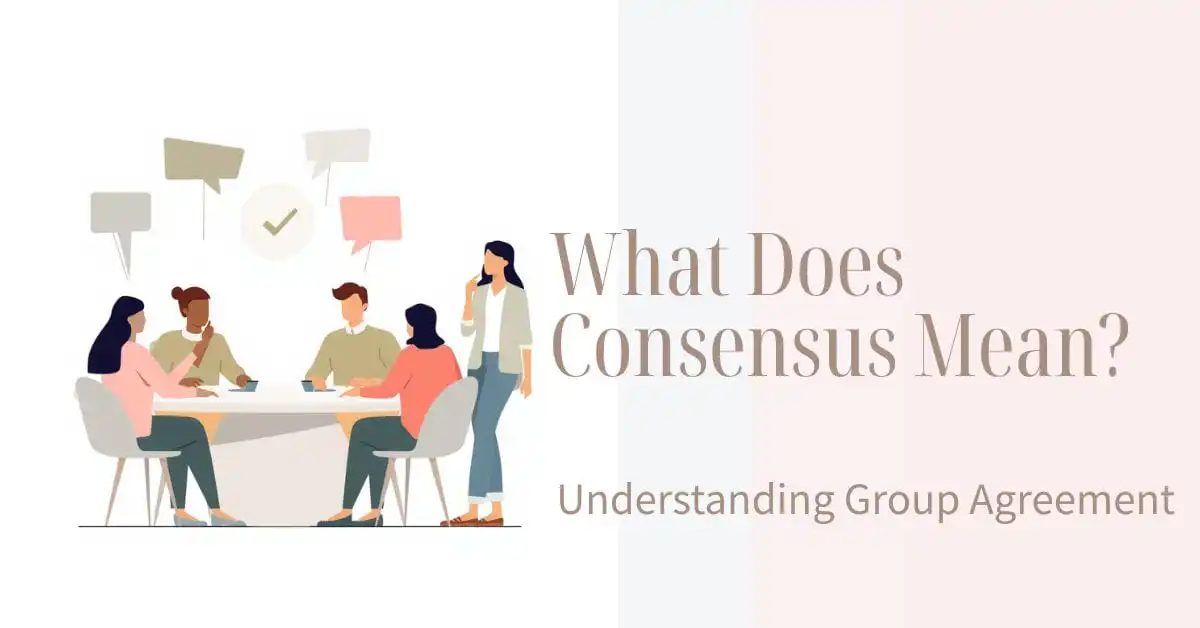
Consensus means general agreement within a group. It does not always mean every person agrees completely. More often, it describes a situation where people are aligned enough on an idea, opinion, or decision to move forward together.
Quick Definition
If you want the simplest explanation, here it is:
Consensus is a shared view or group agreement.
You will often see the word used in meetings, politics, science, classrooms, committees, and everyday conversation. In all of those settings, the basic idea stays the same: several people discuss something and end up broadly on the same page.
In Simple Words
Put simply, the term refers to a group mostly agreeing.
That agreement might involve:
- a decision
- an opinion
- a plan
- a recommendation
- a general view
For example, if a team discusses several options and ends up supporting one direction, that group has reached agreement. Likewise, if experts mostly accept the same conclusion, people may say there is a shared view among them.
So, although the word can sound formal, the meaning is straightforward: people in a group have enough common ground to support the same outcome.
Does It Mean Everyone Agrees?
Not necessarily.
This is the part many readers get wrong. Broad alignment and complete unity are not the same thing. A group may settle on one direction even when a few people still have concerns or would have preferred something else.
That is why it helps to separate this idea from total agreement.
A simple way to think about it
- Broad group agreement = most people support the same direction
- Complete agreement = every person supports it fully
So, if a committee talks through an issue and nearly everyone supports one choice while a few people accept it without fully loving it, that still may be described as group agreement.
Similar Words and How They Differ
The meaning becomes much clearer when you compare it with related terms.
Unanimous
Use unanimous when every person agrees without exception.
Example:
- “The board was unanimous.”
That tells the reader every member agreed.
By contrast, a phrase like “the board reached agreement” suggests strong alignment, but it does not automatically mean every person felt exactly the same way.
Majority
A majority is about numbers. It simply means more than half.
However, a number-based result does not always show real unity. For instance, if 51% support an idea while 49% strongly oppose it, more than half are in favor, but the group is still sharply divided.
Compromise
A compromise happens when people adjust their positions to reach an acceptable outcome.
Sometimes a shared result grows out of compromise. Even so, the two ideas are different. One refers to the end point, while the other focuses on the give-and-take that helped people get there.
Consent
These words are often confused because they sound similar, but their meanings are completely different.
- Consensus refers to agreement within a group
- Consent refers to permission or approval
For example:
- “The team reached agreement.”
- “The patient gave consent.”
Because of that difference, the two should not be used interchangeably.
How to Use It Naturally in a Sentence
Once the meaning is clear, the next step is learning how it usually appears in real speech and writing.
In practice, the word often shows up in common patterns such as:
- reach agreement
- come to agreement
- build support
- approve by agreement
- no clear agreement
Here are a few natural examples:
- “After several meetings, the committee finally reached agreement.”
- “The team came to a shared decision by the end of the discussion.”
- “Leaders spent weeks building support for the proposal.”
- “The recommendation was accepted without a formal vote.”
- “There is still no clear shared view on the issue.”
These examples show how the idea works in real contexts without making the wording sound stiff or forced.
Examples in Real Situations
Seeing the term in different settings makes it easier to understand.
At work
In offices and team meetings, it often describes a decision that people can support, even if not everyone thinks it is perfect.
Examples:
- “The project team agreed on the launch date.”
- “There was no shared position on the budget.”
- “We need stronger support before making a final recommendation.”
In politics
In public discussion, it often refers to broad alignment across a party, committee, or several groups.
Examples:
- “Lawmakers failed to settle on a common position.”
- “There is broad agreement that reform is needed.”
- “The committee has not reached a shared view.”
In science
In scientific writing, the phrase scientific consensus usually points to a conclusion that many experts support after reviewing the available evidence.
Examples:
- “There is strong scientific agreement on the issue.”
- “Researchers have not yet settled on one conclusion.”
- “Experts generally support that view, although debate remains on some details.”
In everyday conversation
Even though the word sounds formal, people also use it casually.
Examples:
- “The group decided on pizza.”
- “Most of us felt it was better to wait.”
- “Everyone was pretty much on the same page.”
Where You Are Likely to See It
The word becomes easier to understand once you notice the kinds of situations where it appears most often.
Meetings and team decisions
In this setting, it usually describes a discussion that leads to a result people can support.
News reports
Journalists often use it when describing shared public, political, or expert views.
For example:
- “There is growing agreement that change is needed.”
- “No common position has emerged.”
Academic or scientific contexts
In research-related writing, it often signals the overall view held by many specialists in a field.
Everyday speech
Although less common in casual conversation than words like agreement, it still shows up when people want to sound more precise.
What “General Consensus” Means
You will often come across the phrase general consensus.
Usually, it means the view that most people in a group seem to share.
For example:
- “The general consensus was that the new policy was confusing.”
Even so, some writers avoid that phrase because the sense of “general agreement” is already built into the word itself. For that reason, editors sometimes see it as slightly repetitive.
A simple rule helps here:
- In everyday writing, general consensus is usually fine
- In tighter writing, the shorter version often sounds cleaner
Common Mistakes People Make
Even after understanding the definition, readers often make the same few mistakes.
1. Assuming it means total agreement
In many cases, it does not. More often, it points to broad support rather than complete unity.
2. Using it for one person
The term applies to a group, not an individual opinion.
Incorrect:
- “My consensus is that we should leave.”
Better:
- “My opinion is that we should leave.”
3. Treating it like a vote count
A formal vote is not always involved. Sometimes people arrive at a shared position through discussion alone.
4. Mixing it up with consent
These two words may sound alike, but they refer to very different things.
5. Keeping it too vague
Clarity improves when you explain who agrees and what they agree on.
Better:
- “Teachers generally felt the timetable was too tight.”
Less clear:
- “There was agreement.”
What Most Articles Miss About This Topic
Many pages define the word as “agreement” and leave it at that. However, the real difficulty is not the basic definition. The harder part is understanding how much agreement the word suggests and how it works in real life.
Here are the points that matter most.
It describes group alignment, not perfect harmony
A few people can still have doubts while the group as a whole supports one direction.
It can refer to both an opinion and a decision
Sometimes it points to a shared view:
- “The general view is that the plan is risky.”
At other times, it refers to the outcome of a discussion:
- “The panel reached a decision after two meetings.”
It appears in more places than people expect
Business, politics, education, science, and daily conversation all use it. That wide range of use is exactly why so many readers recognize the term but still feel unsure about the nuance.
The better question to ask
Instead of asking, “Does everyone agree?” it is usually more useful to ask:
“Is there enough shared support for the group to back one view or move forward?”
In most cases, that is the real idea.
A Quick Way to Interpret It Correctly
Whenever you see this word, ask yourself four things:
- Who is the group?
- What are they agreeing about?
- Is this broad support or complete unity?
- Is it describing a view or the result of a discussion?
That quick check usually makes the meaning much clearer.
When This Word Fits Best
Choose it when:
- several people are involved
- a view is widely shared
- a group has discussed something
- people are aligned enough to support one direction
- you want a more precise term than simply saying agreement
On the other hand, a different word may work better when:
- only one person is involved
- you mean permission
- exact numbers matter
- you want to stress total agreement by everyone
In those cases, words like opinion, consent, majority, or unanimous may be more accurate.
FAQ
What does consensus mean in simple terms?
It means a group generally agrees on something.
Does it mean everyone agrees?
No. In most cases, it points to broad agreement rather than complete unity.
What is the difference between consensus and unanimous?
The first suggests shared support within a group, while unanimous means every person agrees fully.
Is it the same as a majority?
No. A majority is numerical. Group agreement is broader and focuses more on alignment than simple vote totals.
What does “by consensus” mean?
It means a decision was made through shared approval rather than a narrow split.
What does “no consensus” mean?
It means the group has not reached a clear shared position.
Is “general consensus” wrong?
Not exactly. It is common and widely understood, although some editors consider it repetitive.
What does scientific consensus mean?
It refers to a conclusion that many experts in a field support after reviewing the evidence.
Conclusion
So, the clearest answer is simple: consensus means general agreement among a group.
What makes the word slightly tricky, however, is that it does not always mean total agreement. More often, it means enough people share the same view, or support the same decision, for the group to move ahead.
Once you understand that difference, the word becomes much easier to use correctly in meetings, writing, news, politics, science, and everyday conversation.
Click Here To Read About : what does tentatively mean

Hi, I’m Geoffrey Chaucer. I explore the stories and meanings behind words, turning ideas into clear, insightful writing. Through every article I craft, I aim to spark curiosity, share knowledge, and help readers uncover practical, meaningful truths in everyday life.