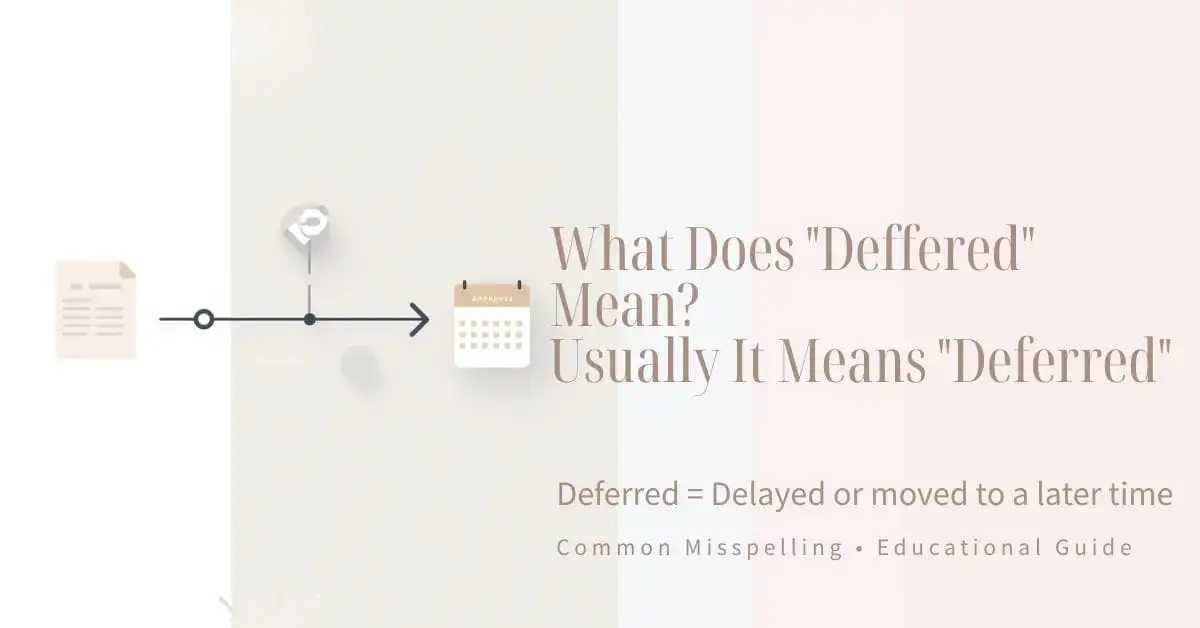
“Deffered” is usually a misspelling of deferred. In plain English, deferred means delayed, postponed, withheld, or moved to a later time. The exact meaning depends on context: a deferred application is reviewed later, a deferred payment is paid later, and deferred revenue is recognized later in accounting. Merriam-Webster defines deferred as “withheld for or until a stated time,” while ACT explains that a deferred college application is reviewed again during the regular admission period.
If you searched “what does deffered mean,” the first thing to know is that you almost certainly mean “deferred.” That is the spelling used by major dictionaries and by real-world sources in business, admissions, and legal contexts.
Is “Deffered” the Correct Spelling?
Usually, no.
The standard spelling is deferred. Dictionary sources list deferred as the adjective form and trace it back to the verb defer, which means to put something off until later. Britannica lists the verb forms as defers, deferred, deferring, and defines defer as choosing to do something at a later time.
That means if you are writing an email, essay, application note, invoice explanation, or blog post, deferred is almost certainly the form you want.
How Do You Pronounce “Deferred”?
A dictionary pronunciation guide for deferred is shown by Merriam-Webster as di-ˈfərd, and Britannica shows defer as /dɪ ˈfɚ/. In everyday plain-English spelling, many readers would say it like “dih-FERD.”
Word family at a glance
- defer = to put off until later
- deferred = delayed or moved to later
- deferral = the act of delaying or postponing something
Merriam-Webster also lists deferral as a nearby related word to deferred.
What Does “Deferred” Mean in Simple English?
The shortest accurate definition is this:
Deferred means not now, but later.
That simple idea covers most uses.
You might see it in sentences like:
- The payment was deferred until next month.
- Her application was deferred to regular decision.
- The board deferred its final vote.
- The company recorded deferred revenue.
In each case, the action, decision, or recognition has been pushed forward in time.
Quick Meaning by Context
| Context | What “deferred” means | What it means for you |
|---|---|---|
| Everyday use | delayed or postponed | it will happen later |
| College admissions | reviewed again later | not accepted yet, not necessarily rejected |
| Billing and payments | paid later | check the new due date and terms |
| Accounting and finance | recognized later | timing matters |
| Legal use | action withheld or delayed | the process may continue later |
This time-based meaning is consistent with dictionary definitions and with common usage examples in admissions and business contexts.
Where People Usually See the Word
In everyday use
In general writing, deferred often just means postponed or put off.
Example:
The committee deferred the decision until Friday.
This is the broadest and simplest use of the word.
In college admissions
In admissions, deferred has a more specific meaning. ACT explains that if you are deferred, the college has postponed the admission decision and will review your application again during the regular admission period. It is not the same as an immediate rejection. ACT also distinguishes deferral from waitlisting: a deferral usually happens in early action or early decision, while a waitlist happens later in the regular admissions process.
Example:
She applied early action, but her application was deferred to regular decision.
In billing and payments
A deferred payment means you do not pay right away. The payment obligation still exists, but the due date is later. Merriam-Webster uses “a deferred payment” as a direct example in its definition.
Example:
The store offered a deferred payment plan for six months.
In accounting and finance
In finance, deferred often means something is recognized at a later time rather than immediately. Dictionary and finance-related sources commonly connect the word with terms like deferred revenue, deferred income, deferred compensation, and tax-deferred. Merriam-Webster specifically lists tax-deferred as a phrase containing deferred, and Cambridge groups the word with business-related entries such as deferred annuity, deferred credit, deferred equity, and deferred income.
Example:
Deferred revenue usually means the business has received money now but will recognize it as revenue later.
In legal use
Merriam-Webster’s legal definition says deferred means withheld or delayed for or until a stated time, and it gives deferred prosecution as an example.
Example:
The case involved a deferred prosecution agreement.
That legal meaning still follows the same core idea: something is not finalized now and may continue later.
Deferred vs Similar Words
People often treat these words as interchangeable, but there are real differences.
| Word | Core meaning | Best use |
|---|---|---|
| Deferred | moved to a later time, often formally | admissions, finance, policies, legal use |
| Delayed | later than expected | travel, schedules, general use |
| Postponed | officially rescheduled | events, meetings, deadlines |
| Waitlisted | placed in a holding pool | admissions, housing, reservations |
| Denied | refused or rejected | claims, applications, requests |
The biggest confusion: deferred vs waitlisted
This matters a lot in college admissions.
ACT explains that a deferral usually happens during early action or early decision and leads to another review in the regular admissions pool. A waitlist, by contrast, usually happens later, after the main review process, when the school may admit more students only if space opens up. ACT also says being deferred is generally more promising than being waitlisted because it gives the application another full review.
So if you see deferred on a college decision, the practical meaning is usually:
You are still in the running, but the school wants to review you again later.
What Should You Do If Your College Application Was Deferred?
This is one area where many basic definition pages stop too early.
ACT recommends practical next steps for deferred or waitlisted students, including checking deadlines, keeping backup options open, improving the application where possible, writing a letter of continued interest, and staying in respectful contact with the admissions office.
A simple way to think about it:
- Read the school’s instructions carefully.
- Follow any update process they allow.
- Send new academic or activity updates only if they are meaningful.
- Keep applying or planning for other schools.
- Do not treat a deferral as either an acceptance or a rejection.
What Most Articles Miss About This Topic
Most articles say “deferred means delayed” and stop there.
That is technically true, but it is not enough to fully help the reader.
The more useful way to understand the word is this:
Deferred is a timing word.
To interpret it correctly, ask one question:
What exactly is being moved to later?
That question solves most confusion fast.
- If a decision is deferred, the answer is coming later.
- If a payment is deferred, the money is due later.
- If revenue is deferred, recognition happens later.
- If an application is deferred, it gets reviewed later.
- If prosecution is deferred, legal action is paused or withheld for now.
Another thing most articles miss is the typo intent behind this query. People often search “deffered” because they heard the word before they ever wrote it. A useful page should correct the spelling quickly, answer the meaning immediately, and then explain the important contexts without making the reader dig.
Common Mistakes People Make
1. Thinking deferred means rejected
Not always.
In college admissions, a deferral usually means the school wants to review the application again later. ACT states clearly that a deferral is not a rejection.
2. Thinking deferred means canceled
Usually, no.
A cancellation ends something. A deferral usually means it still may happen, but later.
3. Assuming the word means the same thing everywhere
The core idea stays the same, but the practical meaning changes by context. A deferred payment, a deferred application, and deferred revenue are not identical situations.
4. Using “deffered” in formal writing
If you are writing professionally or academically, use deferred, not deffered.
FAQ
Is “deffered” a real word?
It is usually treated as a misspelling of deferred, which is the standard dictionary form.
What does deferred mean in one sentence?
It means something has been delayed, postponed, or moved to a later time.
Does deferred mean rejected?
No. In college admissions, it usually means the application will be reconsidered during regular admissions, not rejected immediately.
Is deferred the same as waitlisted?
No. A deferral usually happens earlier and leads to another review. A waitlist usually comes later, after the school has already made most of its admission decisions.
What is a deferred payment?
A deferred payment is a payment scheduled for later instead of now. Merriam-Webster uses that phrase directly as an example of the word.
What does tax-deferred mean?
It generally means a tax obligation is postponed until a later time. Britannica lists tax-deferred as a related form of defer, and Merriam-Webster includes tax-deferred among phrases containing deferred.
What does deferred mean in court or legal documents?
In legal use, deferred usually means something is withheld or delayed until a stated time. Merriam-Webster’s legal entry gives deferred prosecution as an example.
Conclusion
If you searched “what does deffered mean,” the best answer is simple:
You almost certainly mean “deferred,” and it usually means delayed until later.
That basic meaning stays consistent across everyday English, college admissions, billing, finance, and legal use. What changes is what has been pushed to later and what happens next. That is the key to understanding the word correctly the first time.
Click Here To Read More About : what does philanthropist mean

Hi, I’m Geoffrey Chaucer. I explore the stories and meanings behind words, turning ideas into clear, insightful writing. Through every article I craft, I aim to spark curiosity, share knowledge, and help readers uncover practical, meaningful truths in everyday life.