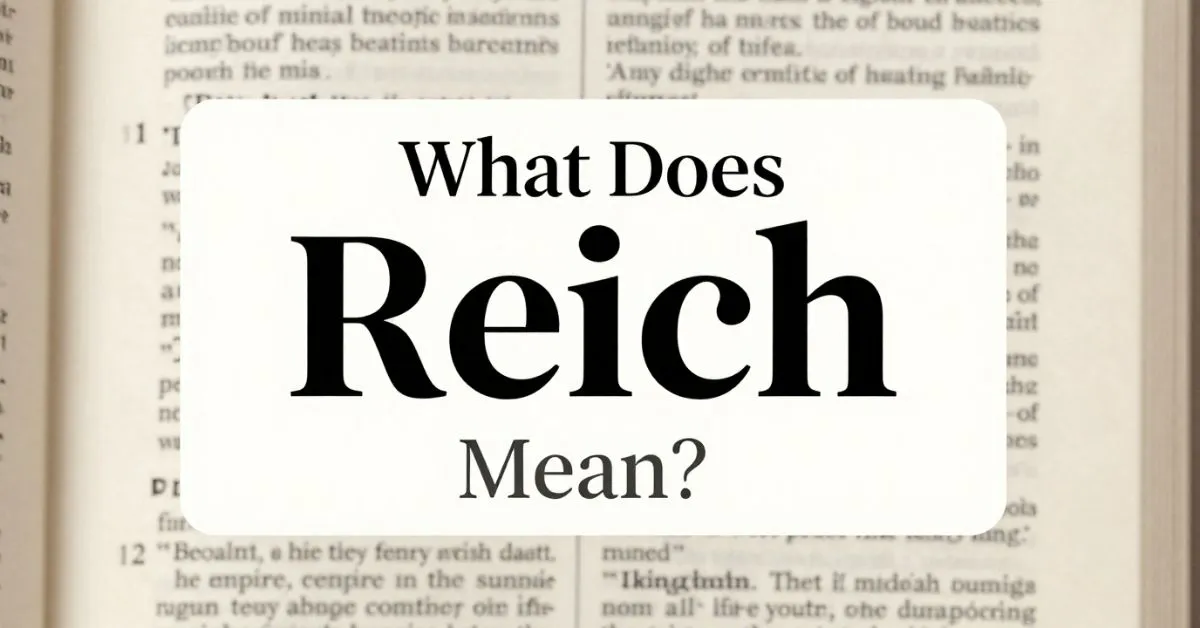
Reich is a German word that usually means realm, empire, or kingdom. In some contexts, it can also be understood more broadly as a state or political domain.
In English, many readers recognize it most from the Third Reich, the Nazi regime in Germany from 1933 to 1945. Lowercase reich is a different German word and usually means rich or wealthy.
If you searched “what does reich mean,” you probably want a clear answer without getting lost in heavy history or language jargon. The key thing to understand is that Reich is not automatically a Nazi word. It is an older German term with broader meaning, but in modern English it often feels politically loaded because of its strong connection to the Third Reich.
The quick answer
In plain English, Reich most often means:
- realm
- empire
- kingdom
- sometimes a state or ruled political domain
That is the basic meaning of the word itself. The reason many people think of Nazi Germany first is that English dictionaries and history references commonly use the Reich or Third Reich in that specific historical sense.
Reich meaning at a glance
| Word | Part of speech | Usual meaning | Common context |
|---|---|---|---|
| Reich | noun | realm, empire, kingdom | German history, politics, translation |
| reich | adjective | rich, wealthy, abundant | everyday German language |
| the Reich | English historical usage | Nazi Germany | World War II and political history |
| Third Reich | proper historical term | Nazi regime in Germany, 1933–1945 | history, Holocaust, World War II |
This simple split is the most important thing to get right before you go deeper.
What does Reich mean in German?
As a German noun, Reich refers to a realm, empire, or kingdom. Merriam-Webster defines it as “realm : empire : kingdom,” while Cambridge’s German-English entry includes empire, domain, and realm among its meanings. That tells you the word has a broader range than one single English translation.
That matters because many readers want one exact English equivalent, but Reich is more flexible than that. In one sentence, realm may sound best. In another, empire may be the better fit.
In some historical or political contexts, state may be the clearest way to explain what is meant. That last point is an interpretation based on how authoritative dictionaries define the word across several overlapping meanings.
Reich vs. reich: the most important distinction
This is the part many competing pages do not explain clearly enough.
Reich with a capital R is usually a noun. It refers to a realm, empire, kingdom, or similar political domain. reich with a lowercase r is usually an adjective meaning rich, wealthy, or sometimes abundant. Cambridge’s German-English entry lists both the noun and adjective senses, and Duden defines reich as having much money or material wealth.
Here are simple examples:
- Das Reich = the realm / the empire
- Er ist reich = he is rich
- Ein reiches Land = a wealthy country
So if you only remember one thing from this article, remember this:
Capitalized Reich and lowercase reich are not the same word in practice, even though they look almost identical.
Why do people connect Reich to Nazi Germany?
Because in English, the most familiar public use is the Third Reich. Cambridge defines the Reich as Germany during the period of Nazi control from 1933 to 1945.
Britannica describes the Third Reich as the official Nazi designation for the regime in Germany from January 1933 to May 1945. The United States Holocaust Memorial Museum also uses Third Reich as another name for Nazi Germany in that period.
That is why the word feels heavy in English. The original German term is broader, but the English-speaking public most often meets it through Nazi-era history. Merriam-Webster’s usage note also says that while the word has older historical use, modern use is overwhelmingly tied to the Third Reich.
Does Reich always mean “empire”?
No. Empire is a common translation, but it is not always the best one.
Depending on context, Reich may be better translated as:
- realm when you want a broad and flexible meaning
- empire when the context is imperial rule
- kingdom in some older or monarchical settings
- state when the point is political structure rather than royal title
This is exactly why a one-word definition can be misleading. The word has a core idea of a ruled domain, but the most natural English rendering depends on the sentence around it.
Which translation is usually best?
For most readers, the safest quick translation is:
Reich = realm or empire
That works in the largest number of cases and matches the way standard dictionaries define it. But if you are translating a historical text, you should still check the exact context instead of forcing one English word every time.
A practical way to choose:
- Use realm when you want a neutral, broad meaning
- Use empire when the historical setting clearly points to imperial rule
- Use kingdom only when the structure is specifically monarchical
- Use state when explaining the political meaning to general readers
That guidance is an informed interpretation based on the dictionary definitions and the way major history references frame the term.
Why is it called the Third Reich?
Britannica explains that the Nazi regime presented itself as the successor to earlier German empires. In that framing, the Holy Roman Empire was treated as the First Reich, and the German Empire of 1871–1918 as the Second Reich. Hitler’s regime then cast itself as the Third Reich. Britannica’s explanation of the phrase says Hitler used that label to place his government in a larger story of German and European history.
That does not mean the word Reich itself was invented by the Nazis. It means the Nazis adopted an older German political-historical term and used it for propaganda and legitimacy.
Where you are most likely to see the word Reich
1. In the phrase “Third Reich”
This is by far the most common recognition point for English readers. If you see the Reich in an English history article without much extra context, it often refers to Nazi Germany.
2. In German history or political discussion
The word can refer more broadly to a realm, empire, or state in historical usage. That broader sense is reflected in standard dictionary definitions, even if English readers do not always think of it first.
3. In German language learning
Language learners may see reich simply meaning rich, wealthy, or abundant. In that setting, there may be no political meaning at all.
Simple examples that make the meaning clearer
Here are a few plain-English examples:
- “The Third Reich ruled Germany from 1933 to 1945.”
Here, the phrase refers specifically to Nazi Germany. - “In German, reich can mean wealthy.”
Here, the word is an adjective, not a historical noun. - “In translation, Reich may be rendered as realm or empire.”
Here, the point is linguistic meaning rather than one specific regime.
These examples show why context matters so much. The same spelling can lead readers in very different directions if they do not notice capitalization, subject matter, or historical setting.
Common mistakes people make
Mistake 1: Thinking Reich always means Nazi Germany
It does not. The word itself is older and broader than Hitler’s regime, even though modern English usage strongly associates it with that period.
Mistake 2: Thinking Reich and reich are the same
They are not. In ordinary German usage, Reich is a noun, while reich is an adjective meaning rich or wealthy.
Mistake 3: Translating Reich as “empire” every single time
That can be too rigid. Depending on context, realm or state may explain the meaning more naturally.
Mistake 4: Treating every appearance of the word as extremist language
That is too broad. The word can appear in neutral dictionary, linguistic, and historical discussion. But because of the Third Reich association, readers should still handle it carefully and contextually.
The best practical takeaway
If you need one clear, reliable answer, use this:
Reich usually means realm, empire, or kingdom in German historical use. In English, many people mainly know it from the Third Reich, which is why the word often feels politically charged. Lowercase reich is different and usually means rich or wealthy.
FAQ
Does Reich mean empire?
Yes, empire is one common translation of Reich, but dictionaries also give realm and kingdom, and the best choice depends on context.
What does reich mean in German?
Lowercase reich usually means rich, wealthy, or abundant in German.
Is Reich always about Nazi Germany?
No. The word is older and broader than the Nazi period, though English readers often connect it to Nazi Germany because of the phrase Third Reich.
What is the difference between Reich and the Third Reich?
Reich is the broader German word meaning realm, empire, or kingdom. Third Reich is the specific historical name for Nazi Germany from 1933 to 1945.
Why does the word feel so loaded?
Because many English speakers know it mainly from Nazi-era history. Cambridge’s English entry for the Reich specifically points to Germany under Nazi control, which heavily shapes modern recognition of the word.
Can Reich mean “state”?
In some contexts, yes. While major dictionaries foreground realm, empire, and kingdom, the broader political sense can be explained as a state or ruled domain depending on the context. That is an interpretive reading based on the dictionary range and the way history sources discuss the term.
Conclusion
The strongest way to understand Reich is by separating the word itself from its most famous historical use. The word itself usually means realm, empire, or kingdom. Its most famous use is in Third Reich, the Nazi regime in Germany from 1933 to 1945. And lowercase reich is a separate word meaning rich or wealthy. Once you make those distinctions, the meaning becomes much clearer.
Read Also These Posts:
What Does Percentage of Rain Mean?
What Does Jehovah Jireh Mean?
What Does Integrate Mean? Complete Guide & Explanation

I am Clara Lexis, a writer driven by clarity, depth, and authenticity. My focus is on transforming ideas into meaningful content that is both informative and engaging. I write with intention to communicate clearly, thoughtfully, and with purpose.