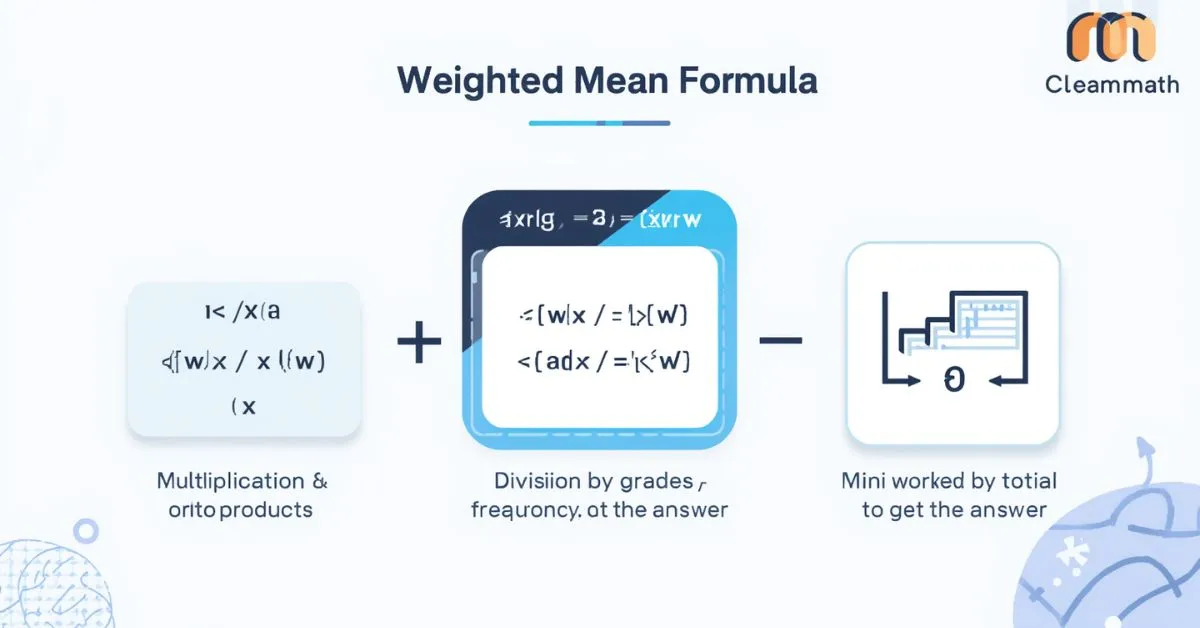
The weighted mean formula is Σ(wx) ÷ Σw. Multiply each value by its weight, add those products, then divide by the total of the weights.
Use it when some values count more than others, such as grades, credit hours, quantities, or frequencies.
The weighted mean formula is:
Weighted Mean = Σ(wx) / Σw
Where:
- x = value
- w = weight
- Σ(wx) = sum of all value × weight products
- Σw = sum of all weights
In simple words, you multiply each value by how much it matters, add everything together, and divide by the total weight.
This is the right formula to use when all values do not count equally.
What Is the Weighted Mean Formula?
A weighted mean is an average that gives more importance to some values than others.
A regular mean treats every value equally:
Mean = Sum of values / Number of values
A weighted mean does not. It gives larger influence to values with larger weights.
That is why the formula is:
Weighted Mean = Σ(wx) / Σw
This is also commonly called the:
- weighted average
- weighted arithmetic mean
- weighted average formula
In most everyday math, statistics, grade calculations, and spreadsheet use, these terms are used in almost the same way.
What Do the Symbols Mean?
Many people understand the idea but get confused by the notation. Here is the simple version:
- x means each data value or observation
- w means the weight for that value
- wx means value × weight
- Σ means “add them all together”
So:
- Σ(wx) means add all the weighted products
- Σw means add all the weights
Then divide the total weighted sum by the total weight.
How to Calculate Weighted Mean Step by Step
Use this process every time:
- Write down each value.
- Write the weight for each value.
- Multiply each value by its weight.
- Add all the products.
- Add all the weights.
- Divide the total product sum by the total weight.
Quick rule to remember
Do not divide by the number of values.
For a weighted mean, you divide by the sum of the weights.
That is the most common mistake.
Weighted Mean Formula With Example
Let’s start with the kind of example most people expect: weighted grades.
Example 1: Weighted mean using percentages
A student’s final grade is based on:
- Homework = 80, weight 20%
- Quiz = 70, weight 10%
- Midterm = 75, weight 30%
- Final exam = 90, weight 40%
Step 1: Multiply each score by its weight
| Component | Score | Weight | Score × Weight |
|---|---|---|---|
| Homework | 80 | 0.20 | 16.0 |
| Quiz | 70 | 0.10 | 7.0 |
| Midterm | 75 | 0.30 | 22.5 |
| Final exam | 90 | 0.40 | 36.0 |
Step 2: Add the products
16 + 7 + 22.5 + 36 = 81.5
Step 3: Add the weights
0.20 + 0.10 + 0.30 + 0.40 = 1.00
Step 4: Divide
Weighted mean = 81.5 / 1 = 81.5
So the student’s weighted mean grade is 81.5.
Weighted Mean From a Frequency Table
This is one of the most important upgrades because many articles skip it, even though it is a very common statistics use case.
Suppose test scores are distributed like this:
| Score | Frequency |
|---|---|
| 60 | 2 |
| 70 | 3 |
| 80 | 4 |
| 90 | 1 |
Here:
- the scores are the values
- the frequencies are the weights
Step 1: Multiply each score by its frequency
| Score (x) | Frequency (w) | x × w |
|---|---|---|
| 60 | 2 | 120 |
| 70 | 3 | 210 |
| 80 | 4 | 320 |
| 90 | 1 | 90 |
Step 2: Add the products
120 + 210 + 320 + 90 = 740
Step 3: Add the frequencies
2 + 3 + 4 + 1 = 10
Step 4: Divide
Weighted mean = 740 / 10 = 74
So the weighted mean score is 74.
Why this matters
This method is useful when values repeat. Instead of writing every score individually, you can use a frequency distribution and let the frequencies act as weights.
Weighted Mean Using Raw Quantities
Weights do not always have to be percentages.
They can also be:
- quantities
- frequencies
- credit hours
- units
- proportions
- relative importance
Example 3: Average price paid per item
You buy:
- 2 notebooks at $5 each
- 5 notebooks at $8 each
- 3 notebooks at $10 each
Here:
- values = prices
- weights = quantities
Formula:
[(2×5) + (5×8) + (3×10)] / (2 + 5 + 3)
= (10 + 40 + 30) / 10
= 80 / 10
= 8
So the weighted mean price is $8 per notebook.
This is a great example because it shows why weighted mean is often more realistic than a simple average.
Weighted Mean vs Simple Mean
A lot of confusion comes from not knowing when to use which average.
| Topic | Simple Mean | Weighted Mean |
|---|---|---|
| Basic idea | Every value counts equally | Some values count more |
| Formula | Sum of values ÷ number of values | Σ(wx) ÷ Σw |
| Best use | Equal importance | Unequal importance |
| Common examples | Basic test average | GPA, final grades, pricing, grouped data |
| Main risk | Ignores unequal importance | Wrong if weights are used badly |
Important point
If all weights are equal, the weighted mean becomes the same as the simple mean.
So weighted mean is not a different kind of answer for no reason. It is the correct average when the situation involves different levels of importance, quantity, or frequency.
Do Weights Have to Add Up to 100?
No.
This is one of the biggest beginner misunderstandings.
Weights can be:
- percentages like 20%, 30%, 50%
- decimals like 0.2, 0.3, 0.5
- frequencies like 2, 4, 6
- credit hours like 3, 4, 2
- quantities like 5 items, 10 units, 30 shares
What matters is this:
- use weights consistently
- divide by the sum of the weights you used
If weights add up to 1
If the weights are normalized and already total 1, then:
Weighted mean = Σ(wx)
because dividing by 1 changes nothing.
Example:
- 10 with weight 0.2
- 20 with weight 0.3
- 30 with weight 0.5
Weighted mean:
(10×0.2) + (20×0.3) + (30×0.5)
= 2 + 6 + 15 = 23
Since the weights already add to 1, the answer is 23.
Weighted Mean Formula in Statistics
In statistics, weighted mean is useful when:
- observations do not contribute equally
- data is summarized in grouped form
- frequencies are used instead of raw repeated values
- survey responses need weighting
- some classes or categories represent larger shares than others
This is why terms like these often appear around the topic:
- observation
- data point
- frequency
- relative frequency
- frequency distribution
- grouped data
- weighted arithmetic mean
- normalized weights
If you are learning statistics, this formula is especially important because it helps you work with summarized data more efficiently.
Weighted Mean Formula for Grades and GPA
Weighted mean is commonly used in education.
Final grade example
A final exam may count more than homework, so the exam should affect the average more.
GPA example
A course with 4 credit hours should affect your GPA more than a course with 1 credit hour.
That is a weighted mean idea:
- value = grade points
- weight = credit hours
This is why GPA is not just a simple average of course grades.
How to Check If Your Answer Makes Sense
This is a useful section many articles miss.
After calculating the weighted mean, ask:
1) Is the answer between the smallest and largest values?
If all weights are positive, it usually should be.
2) Does the result lean toward the values with larger weights?
It should.
For example, if a score of 90 has the largest weight, your final answer should usually move closer to 90 than to the smaller-weight scores.
3) Did you divide by total weight?
If not, the answer is probably wrong.
Common Mistakes When Using the Weighted Mean Formula
1) Dividing by the number of values
Wrong:
Σ(wx) ÷ n
Correct:
Σ(wx) ÷ Σw
2) Mixing percentages and decimals carelessly
Do not mix:
- 20
- 0.30
- 40%
in the same problem unless you convert them properly.
3) Assuming weights must total 100
They do not.
4) Using random weights
A weighted mean is only helpful when the weights actually represent something meaningful, like quantity, credit, frequency, or importance.
5) Forgetting what the weights represent
Always identify this first:
- Are the weights percentages?
- Frequencies?
- Credit hours?
- Number of items?
That makes the calculation much easier to interpret correctly.
Common Wrong Setup vs Correct Setup
| Mistake | Wrong Approach | Correct Fix |
|---|---|---|
| Dividing by number of values | Divide by 4 because there are 4 scores | Divide by total weight |
| Treating all values equally | Use simple mean | Use weighted mean when importance differs |
| Mixing weight formats | Use 20, 0.3, and 40% together | Convert to one consistent format |
| Ignoring frequency tables | Expand every repeated value manually | Use frequency as the weight |
| Using arbitrary weights | Guess importance | Use real, justified weights |
How to Calculate Weighted Mean in Excel and Google Sheets
If you calculate weighted mean often, spreadsheets make it faster.
Excel formula
Use:
=SUMPRODUCT(B2:B5,C2:C5)/SUM(C2:C5)
Where:
- column B contains the values
- column C contains the weights
Google Sheets formula
You can use:
=AVERAGE.WEIGHTED(B2:B5,C2:C5)
or:
=SUMPRODUCT(B2:B5,C2:C5)/SUM(C2:C5)
Tip
Make sure the values range and weights range match row by row.
What Most Articles Miss About This Topic
Most articles give the formula but do not explain the deeper logic clearly enough.
1) Weights are not always percentages
They can also be frequencies, quantities, proportions, units, or credit hours.
2) The denominator is the real key
Many learners memorize the formula but still get wrong answers because they divide by the number of values instead of the total weight.
3) Weighted mean is about influence, not just multiplication
A larger weight gives a value more pull on the final result.
4) Grouped data is where weighted mean becomes especially useful
If you have repeated observations or a frequency distribution, weighted mean helps you calculate the average without listing every data point one by one.
5) A weighted mean is only as good as its weights
If the weights are not meaningful, the final answer can be misleading even if the arithmetic is correct.
Quick Practice Problem
A store sells:
- 4 items at $6
- 3 items at $10
- 3 items at $12
Try it yourself:
Weighted mean = [(4×6) + (3×10) + (3×12)] / (4+3+3)
Answer
= (24 + 30 + 36) / 10
= 90 / 10
= 9
So the weighted mean price is $9.
This kind of quick practice makes the formula easier to remember because you can see the pattern repeat.
FAQ
What is the weighted mean formula?
The weighted mean formula is:
Σ(wx) / Σw
Multiply each value by its weight, add those products, then divide by the total weight.
Is weighted mean the same as weighted average?
In most school, business, and spreadsheet contexts, yes. The terms are often used interchangeably.
How do you calculate weighted mean step by step?
Multiply each value by its weight, add the products, add the weights, then divide the product sum by the total weight.
Do weights need to add up to 100?
No. They only need to be used consistently. You always divide by the total of the weights used.
Can weights be decimals?
Yes. Decimal weights work fine. If they already sum to 1, the formula becomes simpler.
How do you find weighted mean from a frequency table?
Use the values as x and the frequencies as w, then apply:
Σ(wx) / Σw
What is the difference between weighted mean and simple mean?
A simple mean gives equal importance to every value. A weighted mean gives more importance to values with larger weights.
When should I use weighted mean instead of mean?
Use weighted mean when values do not matter equally, such as grades, GPA, grouped data, survey weighting, pricing, or investment allocation.
Conclusion
The weighted mean formula is simple once you understand what the weights are doing.
The rule is:
Multiply each value by its weight, add the results, then divide by total weight.
If all values matter equally, use a simple mean. If some values carry more importance, quantity, or frequency, use the weighted mean.
Read Also These Posts:
What Does Integrate Mean? Complete Guide & Explanation
What Does CC Mean in an Email? When to Use CC vs BCC
What Does Reich Mean? Complete Explanation and Guidence

Hi, I’m Geoffrey Chaucer. I explore the stories and meanings behind words, turning ideas into clear, insightful writing. Through every article I craft, I aim to spark curiosity, share knowledge, and help readers uncover practical, meaningful truths in everyday life.